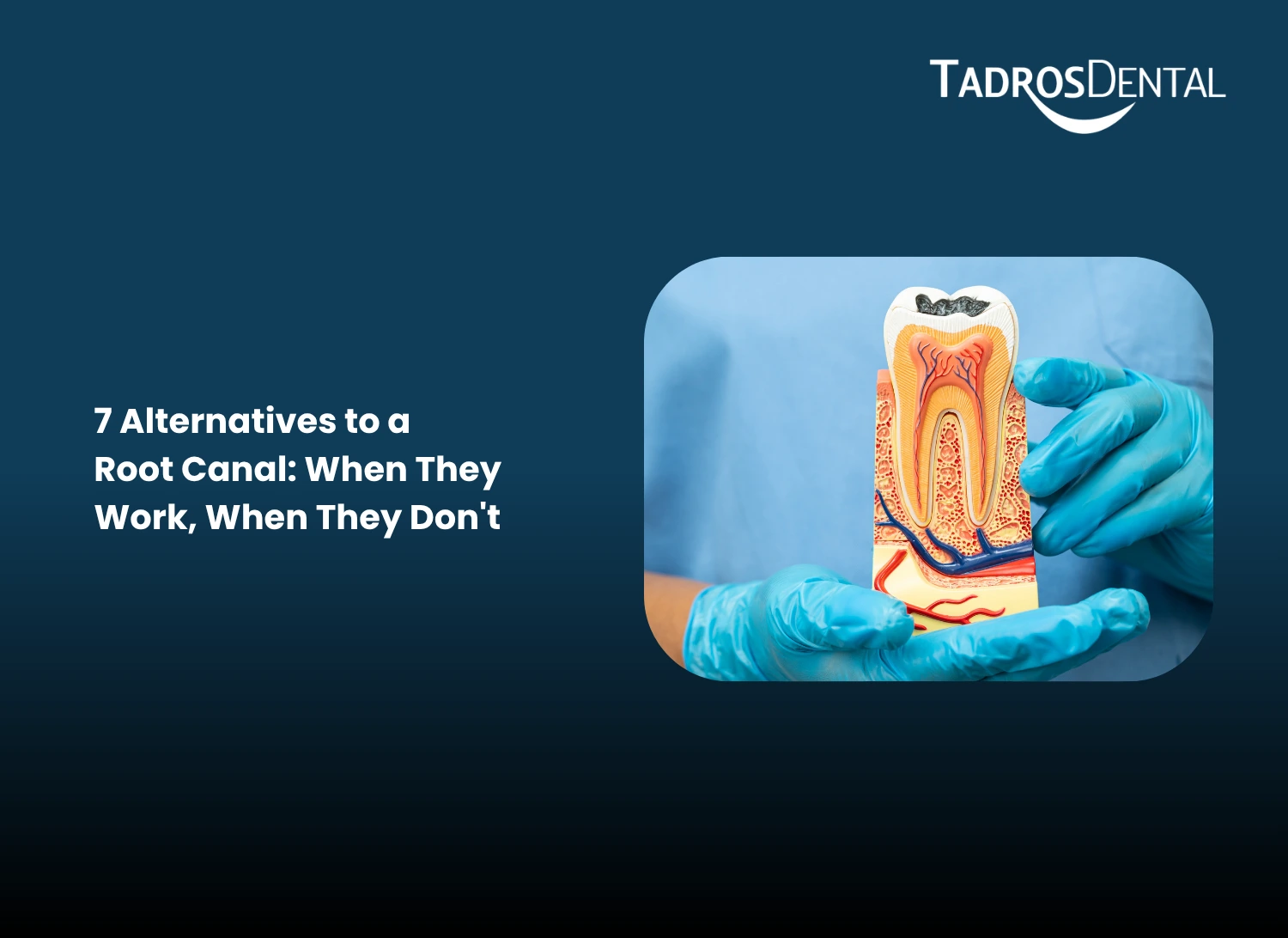
The idea of getting a root canal still makes most people's stomachs drop, even though the procedure itself has come a long way.
But here's what your dentist doesn't always lead with: in some situations, a root canal isn't the only option.
And in others, it genuinely is. Knowing the difference can help you ask better questions and make a more informed decision about your own treatment.
What Is Root Canal Treatment?
A root canal is a procedure that removes infected or inflamed pulp from inside a tooth, cleans the root canals, and then seals the tooth to prevent further infection. It's recommended when the pulp has been damaged by deep decay, a crack, or trauma. The goal is to save the natural tooth rather than extract it.
Why Do People Look for Alternatives to Root Canal Treatment?
Cost is one reason; fear is another. Some patients have concerns about the procedure itself or prefer to explore less invasive options first.
These are all legitimate starting points for a conversation with your dentist, though the right alternative depends entirely on how far the infection or damage has progressed.
Here are seven options worth knowing about, along with an honest look at when each one actually works.
Works when: Decay is caught at the very earliest stage, before a cavity has fully formed.
When minerals start leaving the enamel, the process can sometimes be reversed with professional fluoride treatments, prescription toothpaste, or fluoride mouthwash. If you're looking for top cavity care in Houston, TX, treating early decay can often prevent the need for more extensive procedures later.
This is the only scenario where decay can be addressed without drilling at all. Once a hole has formed in the enamel, this window has closed.
Works when: The pulp is minimally exposed, there is no abscess, and the exposure is very recent.
Pulp capping involves placing a biocompatible material, typically mineral trioxide aggregate or calcium hydroxide, directly over a tiny area of exposed pulp to protect it and stimulate natural dentin formation.
It's a genuinely less invasive option than a root canal when the conditions are right. The key criteria are minimal exposure, no signs of infection spreading into the roots and a healthy surrounding tooth structure. If those conditions aren't met, the procedure is likely to fail.
Works when: Inflammation is confined to the pulp chamber and has not yet reached the root canals. It is most commonly used in children's primary teeth and young permanent teeth.
A pulpotomy only removes the inflamed portion of the pulp inside the crown of the tooth and leaves the root canals intact.
It's a very well-established procedure for pediatric dentistry and for younger permanent teeth where preserving root vitality supports continued development.
In adult teeth with fully formed roots, a full root canal is more commonly the recommendation when pulp involvement is confirmed.
Works when: The pulp is still alive and the infection has not yet reached the root system.
Vital pulp therapy is a broader category of treatments majorly focused on preserving living pulp tissue rather than removing it outright.
Unlike a traditional root canal which removes all pulp, these techniques aim to keep the tooth biologically active. Modern biocompatible materials have significantly improved the success rates of these procedures in recent years.
Works when: Used as a supplementary antimicrobial treatment in early to moderate decay or alongside other procedures.
Ozone therapy uses medical-grade ozone gas or ozonated water to penetrate dental tubules and eliminate bacteria that conventional drilling may not fully reach.
It's gaining traction in biological dentistry as a way to disinfect without removing as much tooth structure. On its own, it is not a substitute for root canal treatment when pulp infection is established but it can play a supporting role in less advanced cases.
Works when: The tooth is too damaged to save, or when saving it is not cost-effective given the patient's overall dental health.
Extraction is the most straightforward alternative to root canal treatment and also the most permanent. It eliminates the infection entirely by removing the tooth.
The downside is that a missing tooth creates its own problems over time, including bone loss in the jaw, shifting of adjacent teeth, and changes to bite function. Beyond restoring chewing ability, replacing a missing tooth can also improve smile appearance and facial aesthetics. Patients looking to enhance both function and appearance can discuss their options with a cosmetic dentistry Houston TX provider.
For this reason, extraction is almost always followed by a replacement option.
Works when: The tooth cannot be saved and a functional replacement is needed.
These are the most common replacement options after extraction, depending on the patient's needs and goals. A dental bridge uses crowns on adjacent teeth to support a false tooth in the gap and typically costs less than an implant. A partial denture is removable and often the most affordable replacement option. A dental implant is the most durable long-term solution with a 95 to 98% success rate according to the American Association of Oral and Maxillofacial Surgeons, though it carries the highest upfront cost. Before choosing an implant, understanding the dental implant price in houston can help patients compare the long-term investment of implants with other tooth replacement options.
So When Is a Root Canal Actually the Right Call?
If the infection has already reached the tooth's pulp and root canals, Houston TX root canals are often the most effective way to preserve the natural tooth.
Here is a straightforward comparison to help frame the decision:
| Situation | Likely Best Option |
| Very early decay, no hole yet | Fluoride remineralization |
| Tiny pulp exposure, no infection | Direct pulp capping |
| Pulp inflammation in crown only | Pulpotomy |
| Living pulp, no root involvement | Vital pulp therapy |
| Established pulp infection | Root canal treatment |
| Tooth too damaged to save | Extraction plus replacement |
Unsure whether you need a root canal or another treatment? Schedule a consultation at Tadros Dental and let our team help you choose the best option for your oral health.
Frequently Asked Questions
Q1 Is there a cheaper alternative to a root canal?
Tooth extraction is typically less expensive upfront than a root canal. However, replacing the extracted tooth with a bridge or implant adds cost over time, so the total expense can end up comparable or higher depending on the replacement chosen.
Q2 When is a root canal the only option?
When the infection has spread into the root canals of the tooth and conservative alternatives are no longer viable.
Q3 Does a root canal hurt?
With modern anesthetics and techniques, most patients report that a root canal is no more uncomfortable than getting a filling. Post-procedure soreness for a few days is normal and manageable with over-the-counter pain relief.
Q4 How do I know if I need a root canal or just a filling?
A filling is sufficient when decay is confined to the enamel and dentin. A root canal becomes necessary when decay or damage has reached the pulp, causing infection or inflammation inside the tooth. Your dentist will confirm this through examination and X-rays.