When you hear the words "root canal," you likely feel nervous, too. This nervousness and fear are the problems that prevent many patients from seeking timely care due to a lack of knowledge of root canals and the process of root canal treatment. This turns a manageable tooth issue into greater pain, stress, and dental issues. This article is there to resolve the confusion. You will get to know what a root canal is, why dentists suggest it, and what the root canal procedure looks like.
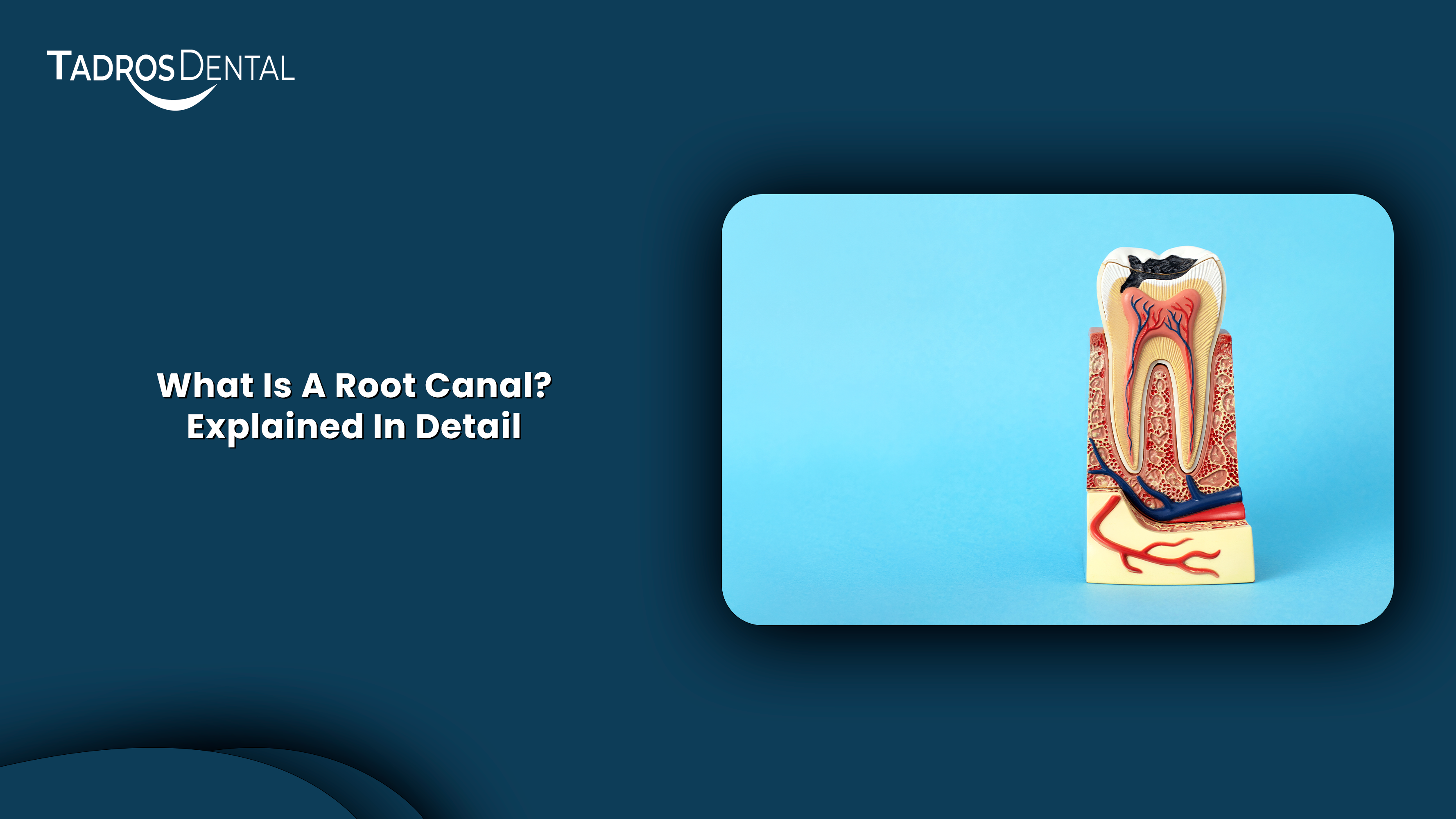
A root canal is a narrow channel inside a tooth’s roots that contains pulp. The pulp, a soft tissue, contains nerves and blood vessels. The inflamed tooth, or one that is infected, often cannot heal itself without dental treatment and a clinical approach. It is at that point that a dentist could recommend root canal treatment.
In simple terms, what is a root canal? It is the canal within your tooth. Root canal treatment is the procedure of cleaning and sealing the infected pulp so that it does not get infected again in the future. The point is to preserve your natural tooth as opposed to extracting it.
You normally require a root canal treatment in cases where the pulp is irritated, inflamed, or infected. That can happen because of:
Signs You Might Notice:
Sometimes, there are no clear symptoms present. It is due to the reason that dentists depend on proper examination, dental X-rays, and imaging rather than signs and symptoms.
What Would Happen to You If You Neglected an Infected Tooth?
An infected pulp normally fails to heal itself. The infection may occur in the teeth internally and be passed over to the tissues surrounding the root. That may cause swelling, an increase in pain, and occasionally an abscess.
Here’s what actually happened during the treatment.
Numbing the tooth
To begin with, the local anesthesia is put in place to ensure that you remain comfortable. When the tooth is numb, it is a lot easier to manage the procedure. And on top of that, the patient will feel less pain and will be comfortable during the process.
The access to the interior part of the tooth
The dentist creates a small hole to access the pulp chamber and the canals within the roots.
Cleaning the canals
The pulp, which becomes infected or inflamed, is then removed. The dentist cleans the interior space and forms the canals in such a manner that they can be sealed well after treatment. The process of cleaning is the most significant part of the root canal treatment since the source of infection is removed.
Filling and sealing
The canals are cleaned, and after filling with a protective substance, the dentist closes the canals. This is aimed at sealing the space to prevent the re-entry of bacteria.
Restoring the tooth
After the tooth is filled, most of them require a crown later on. This is important since a tooth that required root canal treatment might be weaker than it was previously, particularly where there was a massive cavity or crack. A crown aids in safeguarding the tooth during the process of chewing and makes it last longer.
Root canal treatment is done when the tooth is numb, and therefore, you should not experience sharp pains. There could be a degree of pressure or a slight movement, but not that severe pain that many individuals expect.
Tenderness for a few days after treatment is normal, and it usually occurs when you bite or chew. This is usually a result of the fact that the tissue surrounding the root was already inflamed by infection. The pain tends to slowly become less until it disappears as the place heals.
Recovery is usually simple. A good number of the people are back to normal operations the same day. The focal point is that one should be cautious with chewing before the tooth is completely restored.
In case you have a temporary filling, do not chew hard and sticky foods on the tooth. As soon as the final filling or crown is in place, you can normally use the tooth. However, make sure you follow proper dental hygiene with gentle brushing and flossing, or follow as suggested by your dentist. Maintenance of the tooth reduces the risk of future problems around the restoration.
A tooth with root canals could be weaker, in particular, when much structure has been destroyed by decay. A crown acts as a strong and protective shield that prevents further cracks. It also covers the tooth against repeated entry of the bacteria through the small holes. When your dentist suggests a crown, he or she does not want any additional work; he or she wants the tooth to live!
Yes. The alternative that is primarily going to be used is the extraction of the tooth. Following the extraction of teeth, a significant portion of patients opt to replace the extractions, such as with an implant or a bridge, in a bid to improve the ability to chew and maintain the position of teeth.
Nevertheless, in cases where a tooth can be spared, root canal therapy is commonly used, as you retain your natural bite and also the natural tooth structure. To some patients, it is the easiest long-term way of saving the tooth.
Root canal treatment is not a painful treatment. This is a specialized method of eliminating infection within the tooth and enables one to maintain a natural smile. When you know what a root canal actually is and the purpose of the root canal treatment, everything becomes a much less frightening and, at the same time, more feasible process.
If you need root canal treatment, Tadros Dental can provide you with proper step-by-step care and a clear examination of the cause of your tooth pain. Call us today to connect with our experts.