If you are reading this while nursing a throbbing toothache or staring at a dental X-ray, you are likely feeling a mix of anxiety and urgency. At our practice, we see patients every day who are caught in the "save it or pull it" dilemma. The choice between a root canal vs extraction isn't just a clinical decision; it’s a choice that affects your smile, your wallet, and your ability to enjoy your favorite steak or crunchy apple years down the road.
The guide is meant to show patients the long-term effects of the two common procedures: root canal vs extraction. Be it about pain, cost, or recovery, we will uncover the practical truth of both choices so that you may proceed with confidence.
Root canal, or endodontic therapy, is a dental service that has become a dental nightmare for some. Patients are most concerned about the fact that the process is much like that of having a regular filling. It is actually a complex restorative process that is meant to save a tooth that has suffered severe decay or infection.
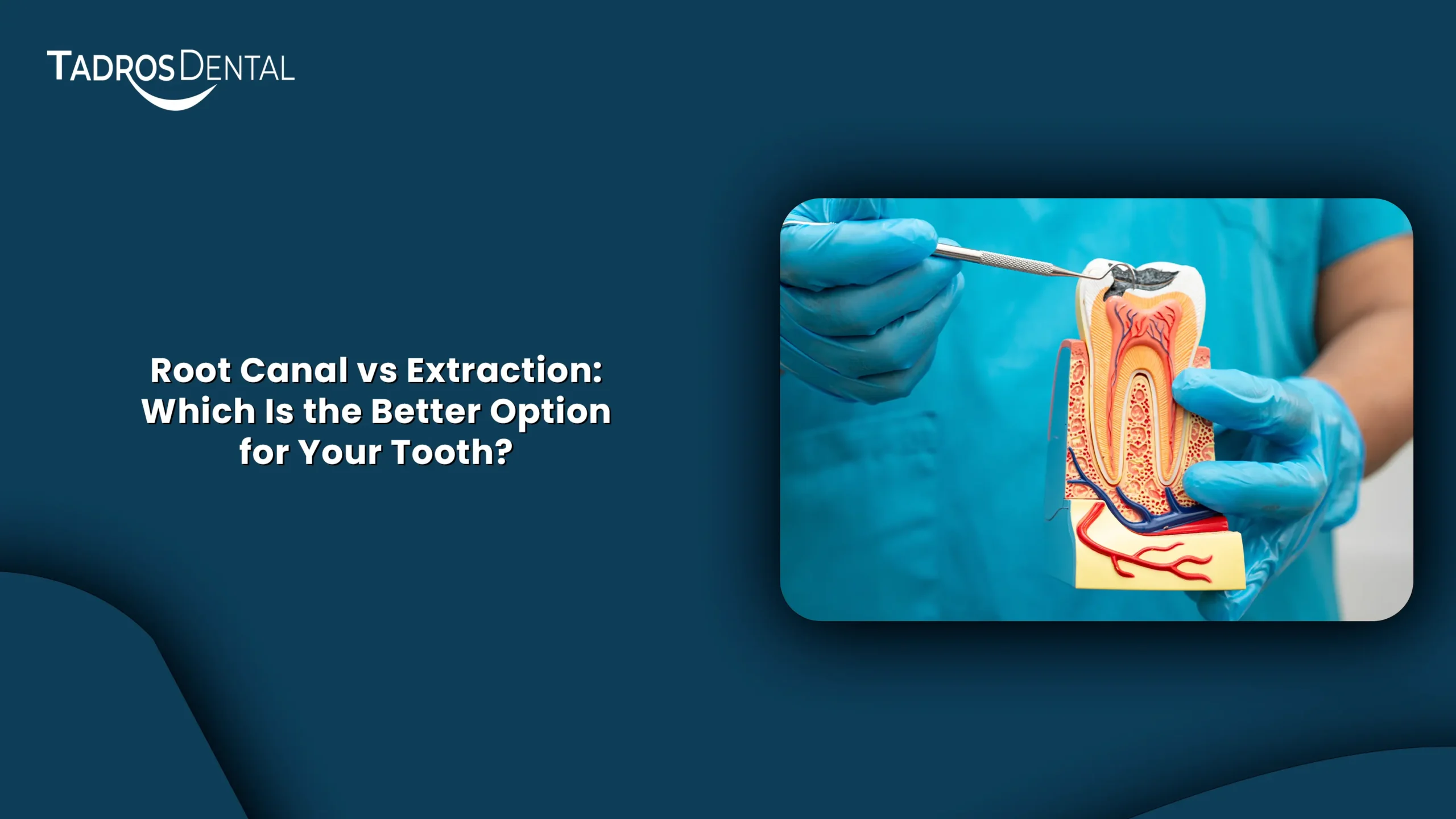
In performing a root canal, we access the inside of the tooth to extract the pulp, the soft tissue that has the nerves and blood vessels, which has become inflamed or infected. After the pulp is taken out, the inside of the tooth is carefully cleaned, disinfected, and shaped. We then fill up the cavity with a rubber-like substance known as gutta-percha and close the tooth opening.
The kind of pain that people refer to when they mention root canals is always the infection that leads to this situation. After the procedure, a dental crown is normally placed on the tooth to restore its strength. If your dentist determines the tooth is still restorable, root canal therapy in Houston can often help you avoid extraction and keep your natural smile intact.
Complete removal of a tooth from its socket in the jawbone is referred to as tooth extraction. Although we would always strive to save natural teeth, we have cases where these teeth are non-restorable. This could be when a fracture goes deep below the gum line or when decay has gone so far as to destroy so much of the tooth structure that a crown cannot be held.
Extraction is a quick process compared to a root canal. We anesthetize the region, use special tools to loosen the tooth, and extract it gently. Nevertheless, it is not the final step in the procedure. When removing a tooth over a root canal, you are putting a hole in your smile. This hole is not merely an aesthetic problem; it can cause bone loss in your jaw, and the rest of your teeth may move, which can destroy your bite formation in the long run. That’s why you need implants later.
|
Feature |
Root Canal Treatment | Tooth Extraction |
|
Primary Goal |
Save and restore the natural tooth. | Remove the damaged tooth entirely. |
|
Procedure Time |
60–90 minutes (may require 1-2 visits). | 20–45 minutes (usually 1 visit). |
|
Pain Level |
Minimal (comparable to a filling). | Minimal during, but more post-op soreness. |
| Recovery | 1–2 days of mild sensitivity. |
3–7 days for initial site healing. |
| Long-term Success | ~94% success rate over 10 years. |
100% removal, but requires replacement. |
| Total Cost | Higher upfront (Procedure + Crown). |
Lower upfront (but higher if adding an implant). |
| Bone Health | Preserves natural jawbone. |
Leads to bone resorption without an implant. |
You can make the choice by understanding these:
Whichever option you pick, your activities in those 48 hours after the operation will see you resume your usual routine much faster.
In the root canal vs extraction debate, the superior choice is normally the one that suits your needs.
If you are confused about your options and seek help, then contact us for a consultation.
With proper oral hygiene and a high-quality crown, a root canal can last a lifetime.
Yes, in most cases. A dental implant or a bridge will be required unless it is a wisdom tooth.
No anesthetics make it painless for both procedures.
An extraction would be cheaper in the short term. But when you add in the price of a replacement (such as an implant), it gets costly. Thus, the root canal can be a better long-term investment.