If you've spent any time researching teeth straightening, you've probably noticed the terms get used like they mean the same thing. They don't, not exactly. Here is the real difference between clear aligners vs Invisalign, and why it matters when you're picking a treatment.
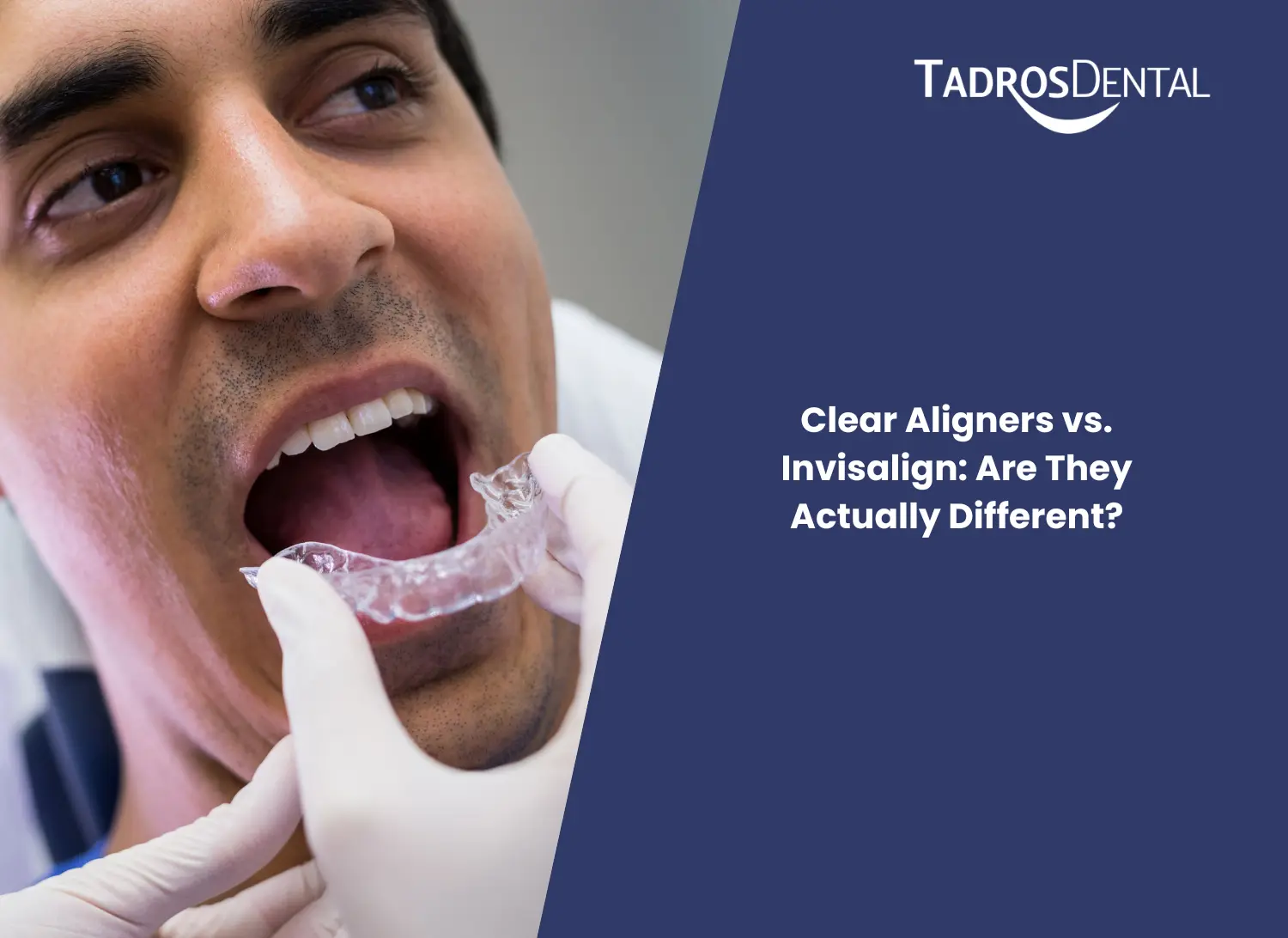
Clear aligners are custom-made, removable plastic trays that gradually shift teeth into a new position and are worn in a series as your bite changes.
"Clear aligners" is the general category. It covers every brand of removable, transparent orthodontic tray on the market, from the one your dentist makes in-house to the big national brands you see advertised online. Invisalign is one specific product inside that category, made by a company called Align Technology.
Align Technology was founded in 1997 and received FDA clearance to sell Invisalign in 1998, making it the original clear aligner brand on the market. Two things set it apart from many other options.
First, Invisalign uses a patented multilayer plastic called SmartTrack, built specifically to apply steady, gentle pressure on teeth over the life of each tray. Second, treatment is mapped out using ClinCheck, a 3D planning tool that shows your dentist (and you) how your teeth are expected to move before any aligners are made.
So when someone asks if clear aligners and Invisalign are the same thing, the short answer is no. All Invisalign trays are clear aligners. Not all clear aligners are Invisalign.
Not quite, and the differences usually come down to material, planning technology, and supervision. Many dental practices, including general dentists, offer their own clear aligner systems built around generic thermoplastic material rather than SmartTrack.
These can work well for mild to moderate cases, though the lack of brand-specific engineering means results can vary more between providers.
There is also a difference in how closely a dentist stays involved. Doctor-supervised aligners, whether Invisalign or another brand, mean a dentist examines your teeth, builds your treatment plan, and checks your progress every few weeks.
Some direct-to-consumer aligner companies skip most of that in-person oversight and mail trays based on an at-home impression kit.
That model has run into real problems. SmileDirectClub, one of the best known mail-order aligner brands, shut down in December 2023 after filing for bankruptcy, and the American Association of Orthodontists has since pushed for closer monitoring of unsupervised aligner treatment.
A dentist isn't just there to hand you a tray. Before any orthodontic treatment starts, your teeth and gums need to be healthy enough to handle the pressure of being moved. Active decay or gum disease can get worse under an aligner if it isn't treated first.
A dentist also catches problems mid-treatment, like a tooth that isn't tracking the way the plan predicted, and adjusts before it becomes a bigger issue.
This is true whether you choose Invisalign or a different doctor-supervised clear aligner system. The brand matters less than whether a licensed dentist is actually checking your mouth along the way.
If your case involves more than mild crowding or small gaps, brand-specific features like SmartTrack and ClinCheck can make a real difference in how predictable your results are.
If your case is simple, a generic, doctor-supervised clear aligner system from your regular dentist may get you the same result for less money. Either way, the decision should start with an exam, not a brand name.
At Tadros Dental in Houston, our Clear Aligner Therapy is doctor-supervised from start to finish. We use digital scanning to map your treatment before a single tray is made, and you'll come in every 6 to 8 weeks so we can confirm everything is tracking as planned.
You can see more on our clear aligner page, or book a consultation to find out which option fits your case and your budget.
1- Is Invisalign always better than other clear aligners?
Not always. For complex cases, its SmartTrack material and attachment system can offer more predictable movement. For simple cases, a generic doctor-supervised aligner often works just as well.
2- Can I switch from a mail-order aligner brand to a dentist-supervised one?
Yes, though your dentist will need to start with a fresh exam and treatment plan. Costs already paid to a mail-order company typically don't transfer.
3- How long does clear aligner treatment usually take?
Most cases run 6 to 18 months, depending on how much movement is needed and how consistently you wear your trays.
4- Do clear aligners work as well as metal braces?
For mild to moderate cases, yes, in most situations. More severe bite issues sometimes still call for braces or a combination approach.
5- Does it matter if my dentist or an orthodontist provides Invisalign?
Both can be trained and certified to offer Invisalign. Orthodontists generally handle more complex bite corrections, while general dentists often manage mild to moderate cases.