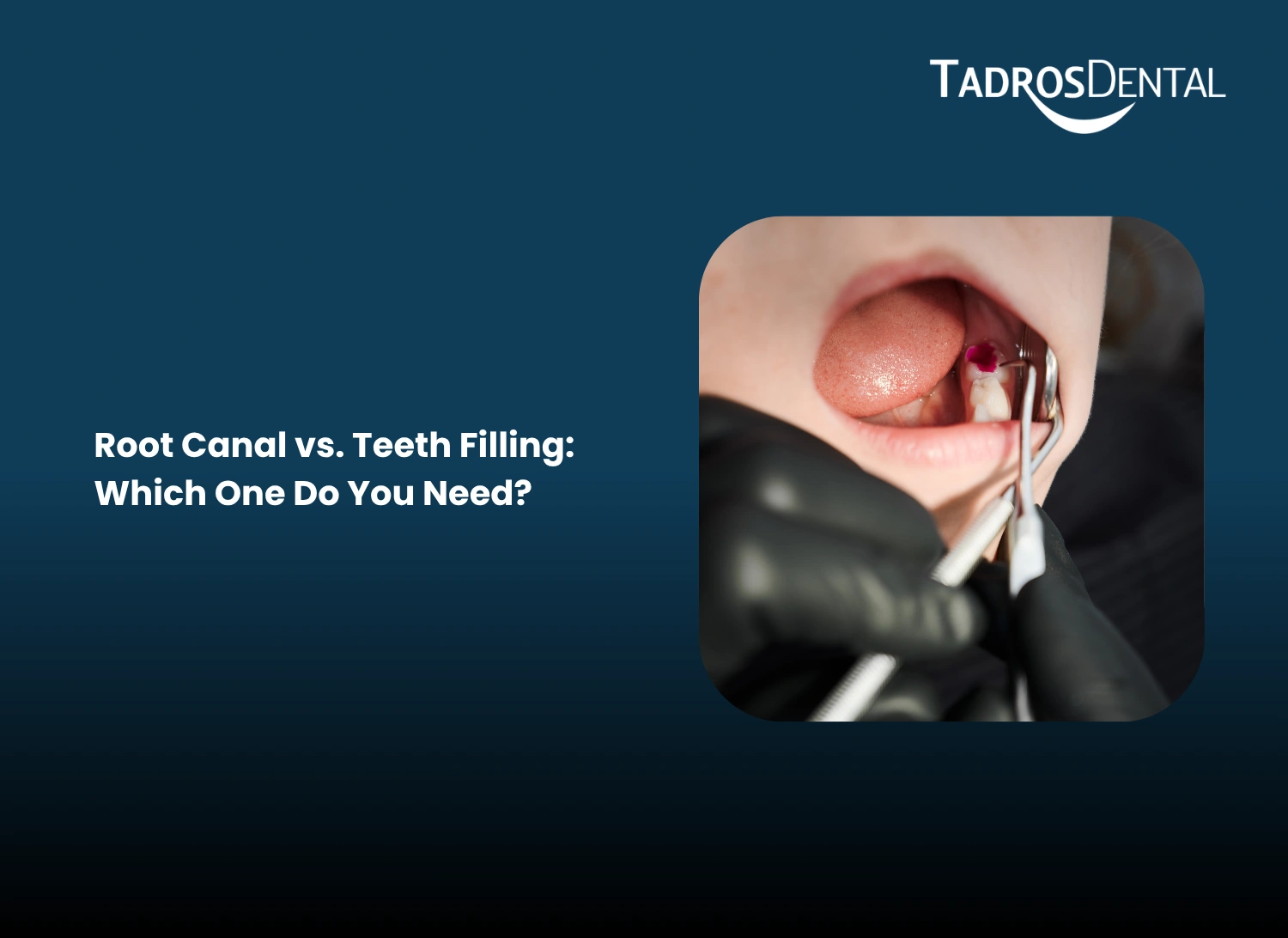
Choosing between a root canal and a tooth filling can be a difficult question for patients to answer.
Both procedures fix damaged teeth. But they treat very different problems at very different stages of damage.
According to the American Association of Endodontists, more than 15 million root canal procedures are performed every year in the United States. That makes it one of the most common dental procedures there is, yet it remains one of the most misunderstood.
A dental filling is a straightforward restorative procedure used when a tooth has a cavity or minor structural damage that has not yet reached the inner pulp.
Here is what the process looks like:
The whole appointment typically takes 30 to 60 minutes. Most patients leave with no lingering discomfort beyond mild sensitivity for a day or two.
The tooth filling price can vary depending on the material selected, the size of the cavity, and the complexity of the restoration. Dental filling costs range from as low as $108 for silver amalgam fillings to as high as $1,774 for porcelain ceramic or gold fillings.
Also Read: Types of Dental Fillings: Materials, Costs & Pros and Cons
A root canal is a bit more of an involved procedure. It becomes necessary treatment if decay or damage has moved past the outer layers of the tooth and into the pulp which is the soft tissue inside the tooth containing nerves and blood vessels.
The major difference is in how deep the problem goes. Fillings can treat the tooth structure. Root canals treat the pulp inside the tooth.
Here is a step-by-step description of the root canal process:
The procedure usually takes one to two appointments depending on the severity of the infection.
According to a study published in Clinical Oral Investigations, the success rate of root canals exceeds 95% after 10 years.
| FACTOR | TEETH FILLING | ROOT CANAL |
| What it treats | Cavity or minor damage | Infected or inflamed pulp |
| Depth of damage | Outer tooth structure only | Reaches the inner pulp |
| Number of visits | Usually one | One to two |
| Anaesthesia | Local | Local |
| Crown needed after? | Rarely | Usually yes |
| Average cost (USA) | $108 to $1,774 | $700 to $1,800 |
| Recovery time | 1 to 2 days sensitivity | A few days of mild soreness |
| Success rate | High with good oral hygiene | Over 95% at 10 years |
Your dentist determines this through an examination and X-rays. But certain signs tend to point clearly in one direction.
Not every cavity requires a root canal, but certain signs may indicate that the tooth needs more than just a filling. Persistent pain, especially when chewing or biting, and lingering sensitivity to hot or cold suggest the pulp is inflamed or infected, which requires treatment beyond a filling.
Q1 What is the main difference between a filling and a root canal?
A filling treats damage that stays within the outer tooth structure. A root canal is needed when the damage or infection has reached the pulp inside the tooth.
Q2 Is a root canal more painful than a filling?
Both are performed under local anaesthesia. Most patients report that root canals are no more painful than getting a filling. The discomfort after treatment is usually manageable with over-the-counter pain relievers.
Q3 Can a tooth that needs a root canal be fixed with just a filling instead?
No. Once the pulp is infected or irreversibly inflamed, a filling cannot address the problem. Only a root canal or extraction can resolve it at that stage.
Q4 How long does a filling last?
Composite resin fillings typically last 5 to 10 years. Amalgam fillings can last 10 to 15 years or longer with good oral hygiene and regular dental visits.
Q5 How long does a root canal last?
With a proper crown placed afterward and good oral hygiene, a root canal-treated tooth can last a lifetime. The 10-year success rate exceeds 95%.