If you have been looking at the types of dental crowns and trying to figure out which option is right for your tooth, you are not alone. Many people delay treatment because they are unsure about the cost, the procedure, or which material will last the longest. That delay can make the problem worse. The Centers for Disease Control and Prevention (CDC) says nearly 21% of adults ages 20 to 64 have at least one untreated cavity, and Healthy People 2030 reports that cost is still a major reason people delay needed dental care.
In this blog, we have explained the types of crowns for teeth, when a crown may be needed, and what can affect the cost in Houston. It also helps you compare the choices more easily.
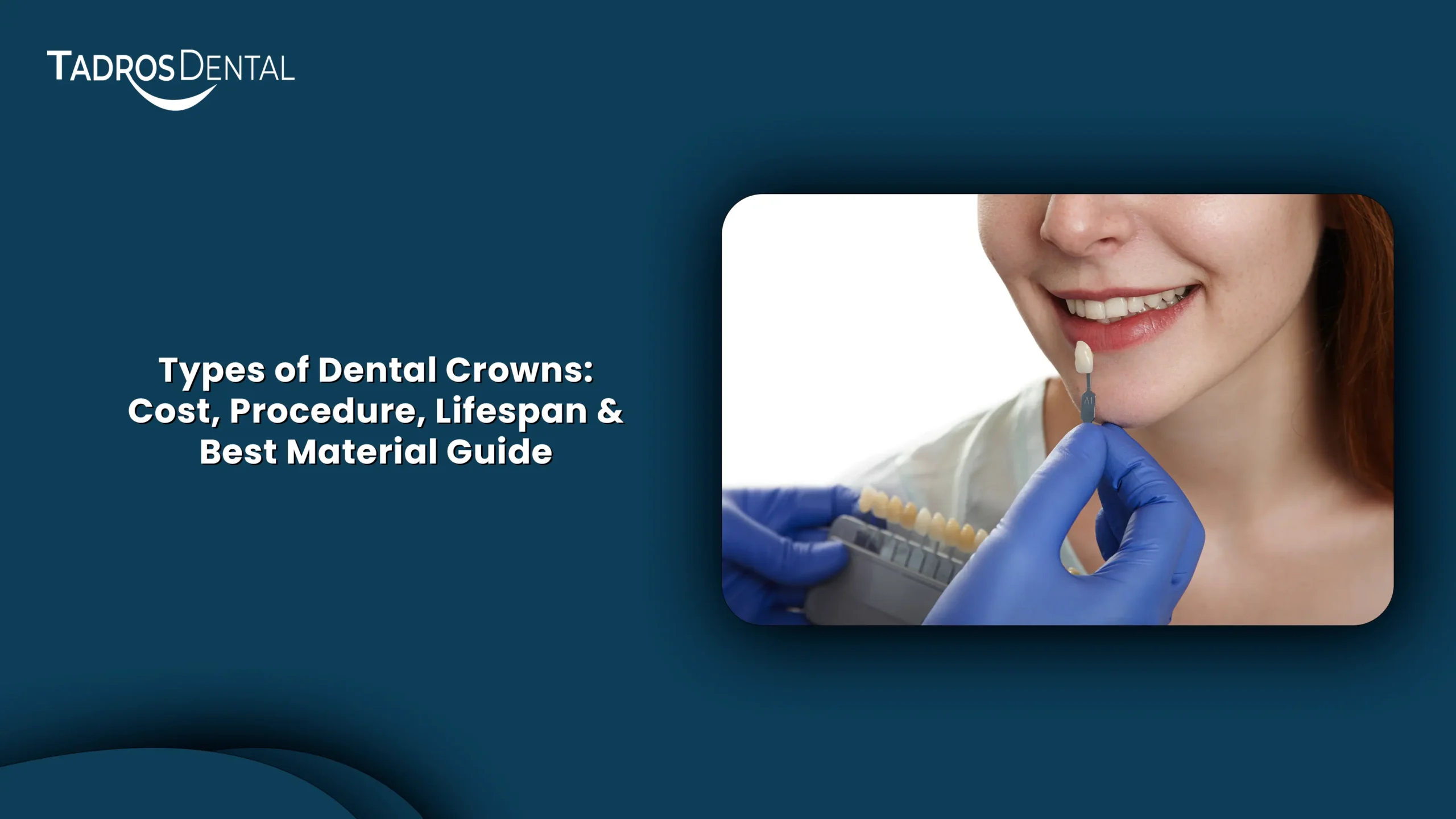
A dental crown is a custom cap that covers a damaged tooth. It helps restore the tooth’s shape, strength, function, and appearance.
A dental crown is different from a filling. A filling repairs part of the tooth, while a crown covers most or all of the visible part above the gumline. That is why crowns are often recommended when a tooth is too weak for a filling alone.
There are several different types of crowns in dentistry, and each one has its own strengths. The best option depends on the tooth location, your bite, your cosmetic goals, and your budget.
Porcelain crowns are known for their natural appearance. They are often used for front teeth because they blend well with surrounding teeth. They look great, but they may not always be the best choice for teeth that handle heavy chewing pressure.
Zirconia crowns are one of the strongest crown types. They are highly durable and work well for molars and for patients who grind their teeth. They may not always look as natural as more translucent materials, but they are a strong choice when durability matters most.
Porcelain-fused-to-metal crowns, also called PFM crowns, have a metal base with a porcelain outer layer. They offer a good balance of strength and appearance. However, over time, the metal edge may become visible near the gumline.
Gold crowns are very durable and hold up well under strong bite pressure. They are usually used on back teeth, where appearance is less important. They last well, but many patients do not want the metallic look.
Resin crowns are usually less expensive than other options. They can be useful in some cases, but they are more likely to wear down or break over time. Because of that, they are often used as a short-term or temporary solution.
Emax crowns are made from lithium disilicate and are popular for their excellent appearance. They are stronger than many older ceramic materials and are often chosen for front teeth and some premolars. They are a good option for patients who want a very natural-looking result without giving up too much strength.
| Crown material | Best for | Main advantage | Main tradeoff | Budget level | Approx. lifespan |
| Porcelain | Front teeth | Very natural appearance | Can be less ideal under very heavy bite force | Moderate to high | 5 to 15 years |
| Zirconia | Molars and high bite areas | Excellent strength and durability | Can look less lifelike than the most translucent ceramics | Moderate to high | 10 to 15+ years |
| Porcelain fused to metal | Front or back teeth in many cases | Good balance of strength and appearance | Metal edge may show over time | Moderate | 10 to 15+ years |
| Gold | Back molars | Long-lasting and very durable | Metallic appearance | Moderate to high | 15 to 20+ years |
| Resin | Temporary or budget focused cases | Lower upfront cost | Wears and breaks more easily | Low | 3 to 5 years |
| Emax / lithium disilicate | Front teeth and selected premolars | Strong esthetics with solid strength | Not always the first pick for heavy grinders or high stress molars | Moderate to high | 8 to 12+ years |
Also Read: Metal Dental Crowns: Cost, Treatment, and Procedures
A crown is usually recommended when the tooth needs more protection than a filling can provide.
If a tooth is chipped, cracked, or fractured, a crown can hold the tooth together and reduce the chance of more breakage. Dentists in practice-based research were especially likely to recommend crowns for fractured or cracked teeth.
After a root canal, especially on a back tooth, a crown is often used to protect the tooth from fracture. Research network findings showed very strong agreement among dentists for crowning posterior teeth after endodontic treatment, and evidence reviews have linked cuspal coverage to better tooth survival in many cases.
When a tooth already has a large filling and not enough healthy tooth remains, a crown may be the safer choice. The ADA’s patient guidance specifically says a crown can strengthen a tooth with a large filling when there is not enough natural tooth left to support that filling.
Crowns are not only about repair. They can also help cover teeth that are badly shaped, badly stained, or uneven in appearance when other cosmetic options are not the best fit. That said, cosmetic use should still be weighed carefully because a crown requires reshaping the tooth.
There is no single best crown material for everyone. The right choice depends on your needs.
For front teeth, appearance is usually the main concern. Materials like porcelain and Emax are often preferred because they look more natural.
For molars, strength matters more. Zirconia, PFM, and gold crowns are often better suited for back teeth because they handle chewing pressure well.
If your main goal is the most natural look, porcelain or Emax often leads the conversation. If your main goal is strength, zirconia and metal-based options usually move up the list. The ADA sums it up well: material selection is always a balance of strength, durability, cosmetic demands, and cost.
Budget matters, but the cheapest option is not always the best long-term value. Resin may cost less upfront, but it is more fragile. A stronger material may cost more now but save you from earlier replacement later. The real question is not only what costs less today. It is what gives you the best mix of function, appearance, and longevity for your case.
The Dental Crown Procedure involves preparing the tooth, taking impressions, placing a temporary crown, and fitting the permanent crown during a follow-up visit. Understanding these steps helps patients know what happens at each stage of treatment.
First, the dentist reshapes the tooth by removing a small amount of enamel so the crown can fit properly. If the tooth needs extra support, some areas may be built up to create a solid base.
Once the tooth is prepared, the dentist takes an impression. This can be done with putty or with a digital scanner. That impression is sent to a lab, where your final crown is made.
Because the final crown usually takes time to make, a temporary dental crown is placed to protect the tooth. Cleveland Clinic notes that this stage often lasts about two to three weeks, and Colgate explains that the temporary crown helps protect the prepared tooth and lets you keep eating and speaking normally while you wait.
At the second visit, the dentist removes the temporary crown, checks the fit, shape, and color of the final crown, and bonds it in place with strong dental cement. Once adjusted properly, it should feel stable and function much like a natural tooth.
The cost of dental crowns in Houston can vary based on the material used, the location of the tooth, and whether other treatment is needed first. In many cases, a dental crown may cost around $800 to $1,700 per tooth, though some crowns may cost more depending on the material and complexity of treatment.
Dental insurance may cover part of the cost if the crown is considered medically necessary. Many plans cover crowns under major restorative care, but coverage depends on your plan details, deductible, waiting period, and yearly maximum.
The final cost can depend on the following:
Need a personalized crown recommendation, a material comparison based on your tooth location, and a clear cost estimate in Houston? You can schedule a consultation through Tadros Dental’s crown and patient financing pages.
Book your visit to Tadros Dental and find the best crown option for your smile.
Most dental crowns last between 5 and 15 years, and many last longer with good care. Lifespan depends on the material, oral hygiene, bite pressure, and whether you grind your teeth.
Crown placement is usually done with local anesthesia, so the procedure itself should not be painful. You may feel mild soreness or sensitivity afterward, but it is usually temporary.
Yes, but you should be careful. Avoid sticky, hard, and very chewy foods because they can loosen or damage the temporary crown.
A filling is used when a smaller part of the tooth needs repair. A crown is used when the tooth is more damaged, weakened, or needs full coverage for protection.