Missing a tooth is not just a cosmetic problem. It can change the way you chew, affect how clearly you speak, and put extra pressure on the teeth around the gap. In the United States, tooth loss is still a real issue, especially as people get older. CDC says about 11% of adults ages 65 to 74 and 20% of adults 75 and older had lost all of their teeth in 2017 through March 2020.
That is where dental bridges come in. A bridge fills the space left by one or more missing teeth and helps restore function, comfort, and appearance. According to the American Dental Association, a bridge literally “bridges” the gap with artificial teeth that are supported by nearby teeth or implants.
In this blog, we’ll walk you through the types of dental bridges, what each one does best, where each one falls short, and how dentists usually decide which option makes the most sense.
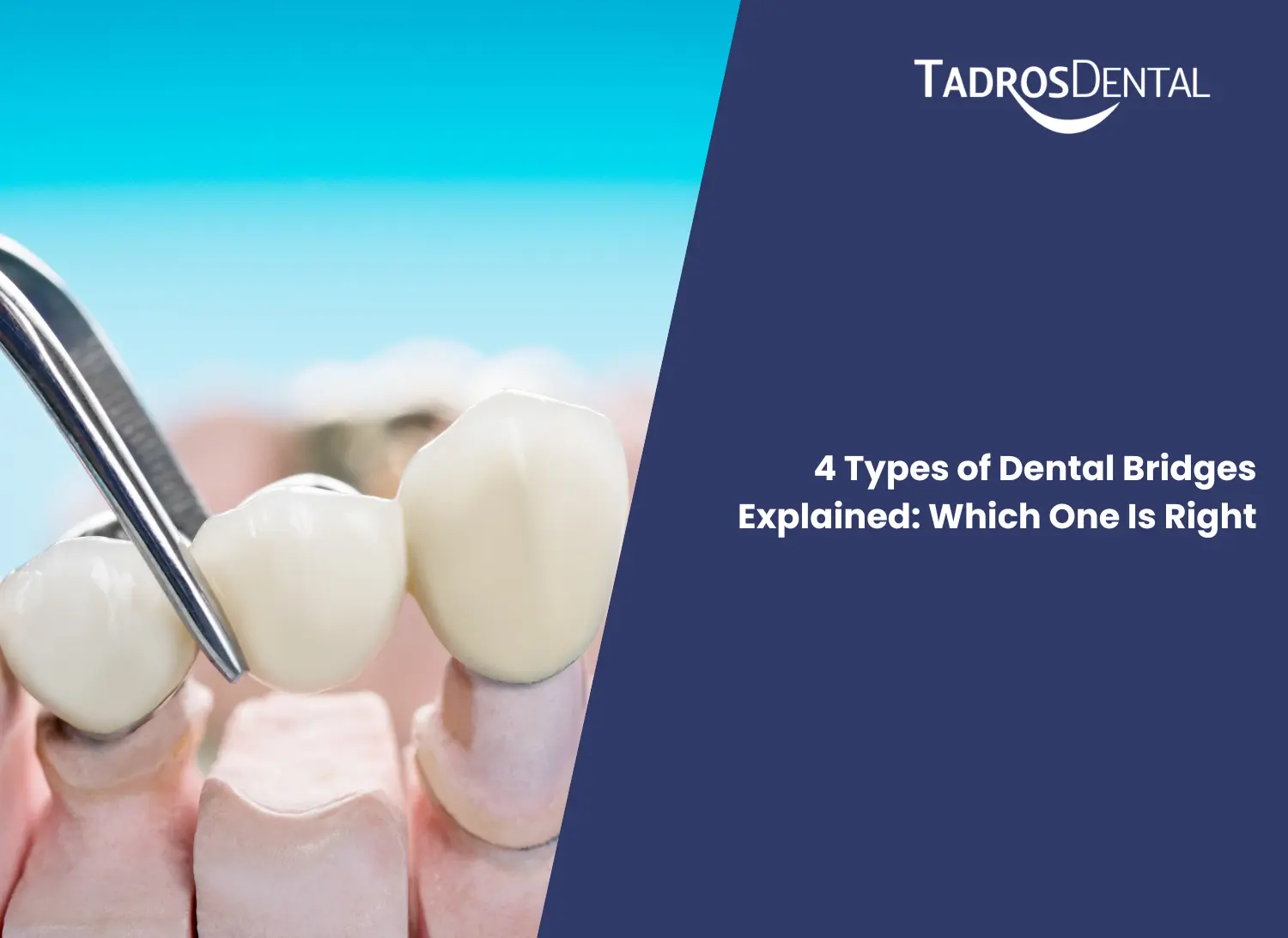
A dental bridge is a fixed tooth replacement used to fill a gap caused by one or more missing teeth. It usually includes one or more artificial teeth, called pontics, plus support on one or both sides. That support may come from natural teeth or dental implants, depending on the design. Unlike a removable appliance, a fixed bridge stays in place and can only be removed by a dentist.
In simple terms, if you are asking, what is dental bridge, the answer is this: it is a custom restoration that lets you chew more normally, supports your bite, and helps your smile look complete again. Bridges can also reduce the risk of nearby teeth drifting into the open space, which can make the bite more uneven over time.
When one tooth is lost, the rest of the mouth often reacts. Chewing can become lopsided. Speech may feel slightly off. Food can collect in the space more easily. Nearby teeth may start to move. Replacing missing teeth sooner rather than later because waiting can allow those shifts to happen.
There is also a bigger oral health picture. WHO says oral disease is largely preventable, but tooth loss and decay are still common worldwide. Dry mouth can also raise cavity risk because saliva helps control harmful germs, according to NIDCR. So when a dentist recommends replacing a missing tooth, the goal is not only to improve appearance. It is also to protect the function and the teeth you still have.
There are four main bridge designs used in modern dentistry. Each one has a different purpose, and each one works best in certain situations.
A traditional bridge is the most common type. It uses crowns placed on the natural teeth on both sides of the gap, with the artificial tooth in the middle.
This is often a good option when the teeth next to the missing tooth are healthy enough to support the bridge. Because it is supported on both sides, it is usually strong and stable.
Before choosing a traditional bridge, dentists evaluate whether the supporting teeth are strong enough. If one of these teeth has infection or extensive damage, a root canal specialist near Houston may be needed to assess whether the tooth can be preserved.
People who have one missing tooth with healthy teeth on both sides of the space
For many patients, this is the most straightforward choice when they want a fixed tooth replacement without surgery.
A cantilever bridge is similar to a traditional bridge, but it is supported on only one side instead of both sides.
This type may be used when there is only one natural tooth next to the gap. Because it has support on one side only, it is not used in every case.
Certain cases where only one support tooth is available
This bridge can be helpful in the right situation, but it requires careful planning.
A Maryland bridge uses small wings attached to the back of the neighboring teeth instead of full crowns. This makes it a more conservative option in some cases.
It is most often used for front teeth because those teeth do not take as much chewing pressure as back teeth.
Replacing a missing front tooth
This option can be a good fit when saving more of the natural tooth matters and the missing tooth is in the front.
An implant supported bridge is held in place by dental implants instead of natural teeth. It is often used when several teeth are missing in a row.
Instead of placing pressure on the teeth next to the gap, the bridge is supported by implants placed in the jawbone.
People missing several teeth in a row
This option is often chosen by patients who want a fixed replacement for multiple missing teeth and do not want to rely on surrounding teeth.
There is no single answer that works for everyone. The right bridge depends on a few important things, including:
A front tooth and a back tooth do not handle pressure the same way. Some bridge types work better in visible areas, while others are better for strong chewing areas.
One missing tooth may need a different solution than several missing teeth in a row.
If the teeth next to the gap are healthy and strong, they may be able to support a bridge. If they are weak, damaged, or already heavily treated, another option may make more sense.
Some people put more force on certain teeth when they chew or grind. That can affect which type of bridge will last best.
Some patients prefer a bridge that does not involve surgery. Others are open to implants if it gives them better long term support.
If you are weighing implants against a bridge, our guide on dental implant vs dental bridge can help you compare both options in detail.
If you want a quick and easy way to understand the different types of dental bridges, here is a simple breakdown:
The life of a bridge depends on the type of bridge, how well it was planned, and how well you take care of it at home. Good brushing, flossing, and regular dental visits matter a lot.
A bridge is not something you place and forget. It still needs daily care. Food and plaque can build up around it, especially under the artificial tooth. Keeping the area clean helps the bridge last longer and protects the support teeth and gums.
The type of bridge you choose can also affect the overall cost. If you want to understand what to budget for, our guide on dental bridge cost in Houston breaks down pricing by bridge type and what factors influence it.
Once you get a bridge, good care becomes part of the treatment.
Small problems are easier to fix when they are caught early.
Understanding the types of dental bridges can make the decision feel much less confusing. Each bridge has its own purpose. Some are best for front teeth. Some are better for strong chewing areas. Some rely on natural teeth, while others rely on implants.
The best choice depends on your mouth, your bite, your goals, and the condition of the teeth around the gap. That is why a proper exam matters. What works well for one person may not be the best option for someone else.
If you are missing a tooth and want a fixed solution, learning about dental bridges is a smart first step. A well-planned bridge can help restore comfort, function, and confidence in your smile.
Ready to find the right bridge for your smile? Visit Tadros Dental to book a consultation and explore your treatment options.
A personalized exam can help you choose the bridge that fits your needs and protects your smile for the long run.